
If you’re going through something difficult - whether it’s online or offline sexual harm, thoughts of harming yourself or others, or simply feeling overwhelmed, help is available. You are not alone.
In an emergency: If you're concerned about the immediate safety of yourself or someone else, call 111.
Experiencing online abuse?
Harassment, cyberbullying, image-based abuse/deepfakes, sextortion, online blackmail, ‘revenge porn’? Get help. Netsafe provides free support, advice, and education for all ages. As the Approved Agency under the Harmful Digital Communications Act 2015 (HDCA), it assesses and investigates complaints about harm caused by digital communications, using advice, negotiation, mediation, and persuasion to help resolve them.
If you experience online abuse/harm:
Take screenshots
Report it in the app or platform
Contact Netsafe
Text 'Netsafe' to 4282
Call 0508 638 723
Online chat at netsafe.org.nz
Experiencing Sadistic Online Exploitation?
If you or someone you know is in immediate danger, call 111.
Next Steps:
Stop the chat immediately.
Take screenshots of the offender’s username, profile picture, and messages (ensure dates and times are visible or manually recorded).
Report and block the account on the platform.
Report the incident to New Zealand Police:
– Call 105 or report online at www.police.govt.nz/use-105
Find out more about sadistic online exploitation at NZ Police.
For immediate emotional support
Call or text 1737 anytime for free national counselling
Youthline — 0800 376 633, or free text 234.
If you've experienced sexual assault or abuse and need to talk to someone,
Contact Safe to Talk/Korero Mai confidentially, any time 24/7:
Call 0800 044 334, Text 4334, Email support@safetotalk.nz
For more info or to web chat visit safetotalk.nz
Alternatively, contact your local police station - click here for a list.
Are you concerned about someone else’s or your own online behaviour?
Are you worried about what you are watching? Are you experiencing sexual thoughts that involve harm towards others? Safe and confidential support is available for you and/or your family.
Stop: South Island www.stop.org.nz
Email: info@stop.org.nz
Call 03 353 0257
WellStop: Lower North Island www.wellstop.org.nz
Email: info@wellstop.org.nz
Call 04 566 4745
Safe Network: Northern North Island. www.safenetwork.org.nz
Email: info@safenetwork.org.nz
Call 09 377 9898

What should I do if I see or find content that I think is illegal?
The Department of Internal Affairs (DIA) investigates people who create, collect or share child sexual abuse material. If you see any content that you believe is illegal, you should leave the website immediately and report it to their Digital Child Exploitation team:
Not sure what counts as illegal, harmful, or objectionable?
RESOURCES AND RESEARCH
-

TakeItDown.org
Having nudes online is scary,
but there is hope to get it taken down.This service is one step you can take to help remove online nude, partially nude, or sexually explicit photos and videos taken before you were 18.
-
Grooming & Child Exploitation Education
Department of Internal Affairs (DIA) works to educate people on issues related to online safety and child sexual exploitation.
Keep it Real Online : an online hub with information to raise awareness of the online harms faced by rangatahi and tamariki with information, tools and resources for parents, educators, and youth on a range of online harms such as porn, bullying, relationships, grooming, and misinformation. https://www.keepitrealonline.govt.nz/
-
Illegal and harmful content: resources for supporting young people-Classification Office
These resources, from the Classification Office, include insights from young people and what it means for adults supporting them. They have been peer reviewed by Youthline NZ and clinical psychologist Dougal Sutherland from Umbrella Wellbeing.
-
Conversation Starters About Harmful Content Online-Classification Office
Talking with our kids about what they might come across online is one of the best ways to help keep them safe. Here are some questions and ideas to help get you started.
-

Why we need to talk about porn, Jo Robertson, TEDx 2019
With one in four children being exposed to online porn by the age of twelve or younger, it's critical we know what they're seeing—and it's critical we talk to them about it.
-

Tricky Chats Online Course
Parenting expert and educator Jo Robertson gives a step-by-step guide for all things screens, safety & sexual wellbeing with 17 videos covering consent, puberty, online safety, ‘stranger danger’, sleepovers and more.
-
Social Media Sorted: A parent's guide
This self-guided online course from Parenting Place offers practical ways to go slower, build safer boundaries, strengthen connection and respond calmly when challenges arise. Holly Brooker offers expertise.
-
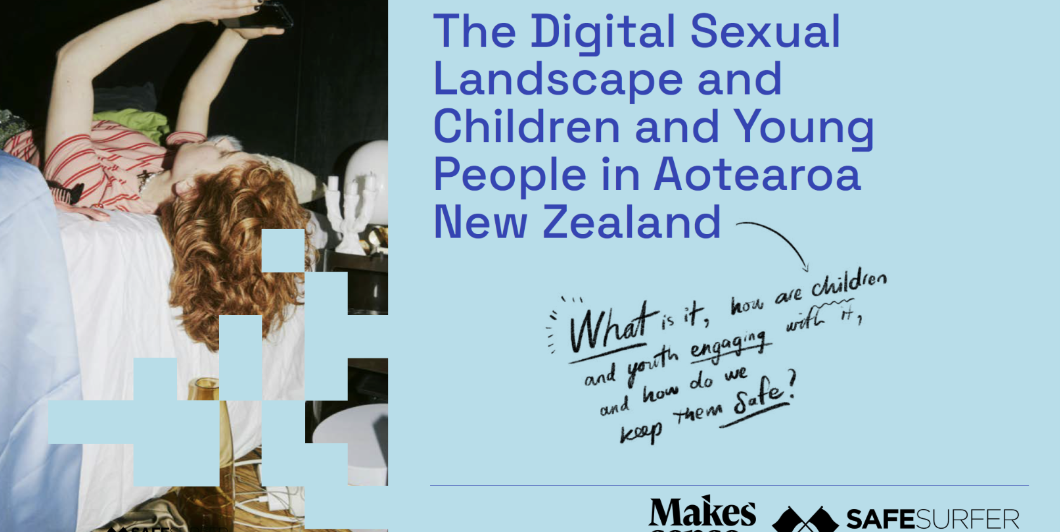
Digital Sexual Landscape Report, Children and Young People
This report was commissioned by ACC and co-authored by Makes Sense & Safe Surfer, with contribution from Nikki Denholm, The Light Project NZ. It highlights the urgent need to protect young people from digital sexual harms, while also empowering them to navigate the online world safely.
-

Algorithims 101-Classification Office
Here’s a quick overview on how algorithms work to give us an idea of why extremely harmful content might be appearing in a newsfeed. Knowing about algorithms and how they work can help us to talk with rangatahi about how they can try to control or ‘curate’ their online experience in a positive way.
-

The Light Project
An evidence based NZ website for parents, caregivers, professionals and young people on how to positively navigate the new porn landscape
-
Addressing Sexual Violence in NZ, The Helen Clark Foundation & The Clare Foundation, 2025
NZ is ranked in the Women, Peace and Security Index as one of the safest places in the world to be a woman but rates of sexual violence are higher than in comparable countries.
-

Youth Perspectives on Online Safety, THORN 2023
Thorn’s annual report of Youth Perspectives on Online Safety represents the fifth year of data collection on youth behaviors and attitudes toward online safety topics. This year expands to include emerging threats such as AI-generated CSAM (“deepfake nudes”) and sextortion.
-

Teens and Porn Report Infographic 2022
This infographic highlights the key takeouts and results from the 2022 Commonsense Research into Porn and Teens.
-

Teens and Porn Report- Commonsense Media 2022
This new report explores how a demographically representative sample of US teens engaged with or experienced porn online.
-

NZHerald How to talk to your kids about porn, sex and technology.
Tips on how start and continue the conversations around porn, sex, and tech, with our kids and how to keep them safe online.
-

NZ Youth and Porn Report 2018
Research findings of a survey on how and why young New Zealanders view online pornography
-

Harmful Social Media Algorithms & Children with Imran Ahmed - Screen Deep podcast March 2025
On this episode, host Kris Perry talks with Imran Ahmed, founder and CEO of the Center for Countering Digital Hate, about the hidden dangers of social media algorithms, the risks youth face on various popular platforms, and the urgent need for transparency and accountability in digital spaces.